THE LATEST IN ROOFING
Performance: What Really Determines the Price of Stone Coated Metal Roof Tiles?
When comparing stone coated metal roof tiles, buyers often notice a significant difference in price between products that appear almost identical. At first glance, two tiles may have the same profile, similar colors, and comparable surface texture. So why can their prices be so different?
The answer is often hidden beneath the surface.
The real difference is in the materials, coating system, manufacturing process, and quality control.
For roofing products, a lower purchase price does not always mean a lower total cost. A tile with thinner steel, less protective coating, weaker stone adhesion, or inconsistent production may require more maintenance and offer less reliable long-term performance.
At SANGOBUILD, we believe that understanding the structure of a stone coated metal roof tile is the first step toward making a better roofing investment.
What Makes One Stone Coated Metal Roof Tile More Expensive Than Another?
A stone coated metal roof tile is not simply a piece of steel covered with colored stone. It is a multi-layer roofing system in which every layer contributes to the final performance.
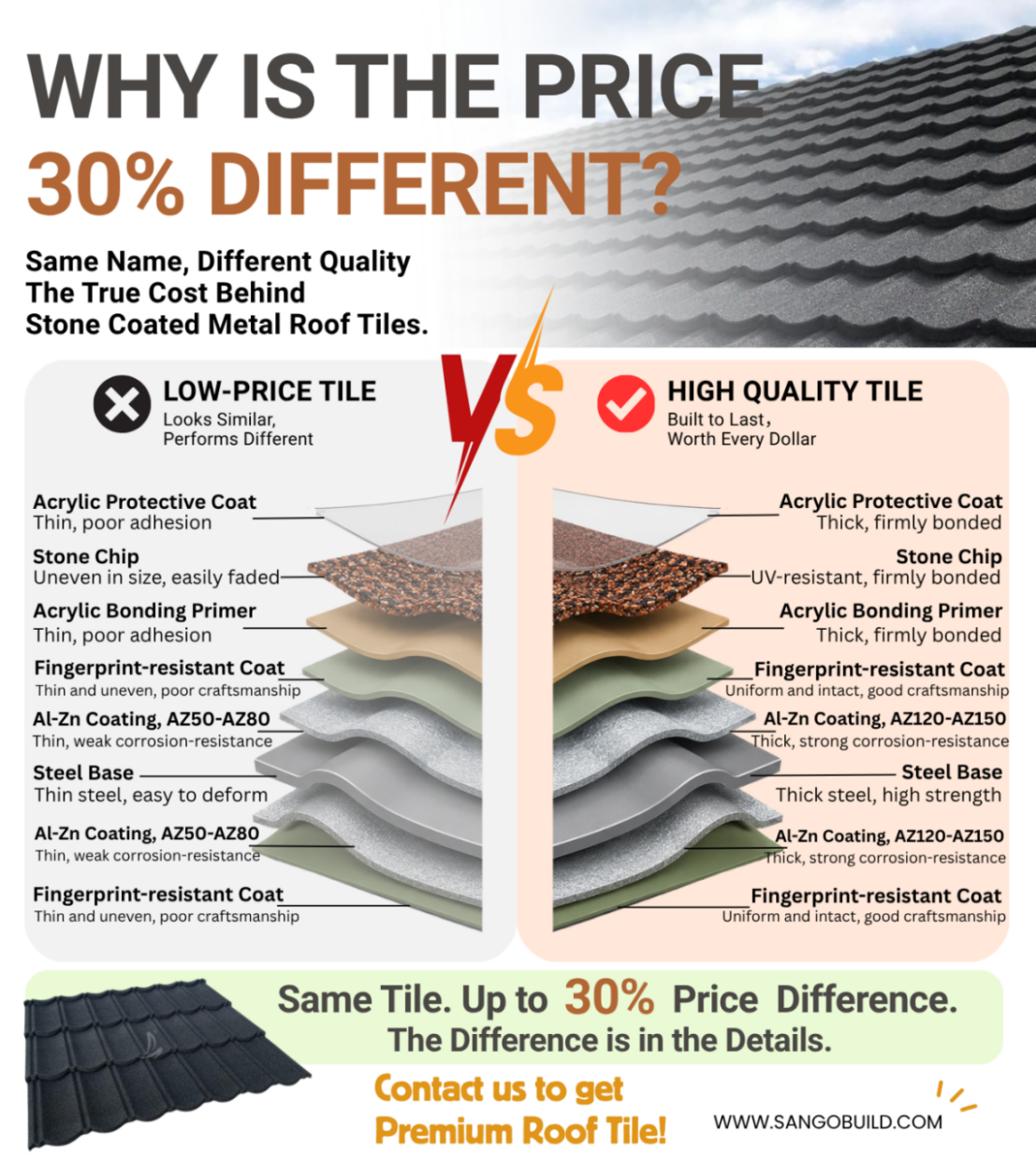
A typical SANGOBUILD stone coated metal roof tile consists of a protective coating system, natural stone granules, acrylic bonding layers, an aluminum-zinc coated steel substrate, and additional protective treatment.
This means that two tiles with the same appearance can perform very differently when their internal specifications are not the same.
1. Steel Base: The Foundation of Roof Strength
The steel substrate is one of the most important factors affecting the quality and price of a stone coated metal roof tile.
A thicker and stronger steel base provides better structural stability and resistance to deformation during transportation, installation, and long-term use.
Lower-cost products may reduce material consumption by using thinner steel. While the finished tile may still look attractive, the difference becomes apparent when the roof is exposed to demanding conditions.
For this reason, buyers should look beyond the surface and ask:
What is the actual steel thickness?
What type of steel is being used?
What is the coating specification?
SANGOBUILD uses aluminum-zinc coated steel as the substrate for its stone coated roofing products, providing a protective barrier against corrosion.
2. Aluminum-Zinc Coating: Small Specification, Big Difference
The aluminum-zinc coating is another key factor that can significantly affect roofing performance.
The image comparison highlights the difference between lower coating specifications such as AZ50–AZ80 and higher specifications such as AZ120–AZ150.
A higher coating weight means more protective metallic material is applied to the steel surface. This can provide stronger corrosion protection when the roofing system is exposed to moisture and challenging environments.
For projects in coastal, tropical, humid, or high-rainfall areas, this specification deserves particular attention.
Don't compare prices before comparing AZ specifications.
A cheaper tile may simply be using less protective material.
3. Stone Granules: More Than Just Color
The stone granules are the most visible part of a stone coated metal roof tile, but their quality is often overlooked.
High-quality granules provide:
A natural textured appearance
Better surface protection
Improved color stability
Stronger resistance to environmental exposure
However, not all colored granules are the same. The quality of the mineral, coloring process, particle consistency, and surface treatment can all affect the finished roof.
SANGOBUILD uses natural stone granules with ceramic coating technology, designed to improve color retention and weather resistance.
This is why two roof tiles with the same color name can look different after years of exposure to sunlight.
4. Stone Adhesion: Why Does the Stone Stay on the Tile?
A stone coated metal roof tile depends on a strong adhesive layer to secure the granules to the steel substrate. If the adhesive is weak or applied unevenly, excessive granule loss can occur during transportation, installation, or long-term exposure.
A professional bonding process should provide: Uniform coverage + strong adhesion + consistent curing
The result is not simply a better-looking tile - it is a more carefully engineered roofing surface.
Why SANGOBUILD Focuses on Quality Behind the Surface
For SANGOBUILD, quality is not determined by appearance alone.
Our stone coated metal roofing systems are developed around a multi-layer construction that combines aluminum-zinc coated steel, protective coatings, acrylic bonding layers, and natural stone granules.
The goal is simple: Build a roof that performs as well as it looks.
For distributors, contractors, developers, and homeowners, this means evaluating the complete roofing specification, rather than choosing a product based solely on the lowest initial price.
The Real Cost of a Roof Goes Beyond the Purchase Price
A lower-priced tile may look attractive at the quotation stage. But if the product has inadequate corrosion protection, poor stone adhesion, inconsistent coating, or insufficient structural strength, the initial saving may not represent the best long-term value.
A quality roofing system should be evaluated based on: Material Quality + Manufacturing Quality + Weather Performance + Service Life + Total Value
That is why the price difference between two seemingly similar stone coated metal roof tiles can be significant.
The difference may not be visible from the roof surface. It is in the details.
SANGOBUILD - Roof Right, Build Bright.


REQUEST A QUOTE
Copyright © Hangzhou Singer Building Materials Co., Ltd. All Rights Reserved |
Sitemap
| Powered by 


SEOKeywords:Roof Tile ManufacturerRoof Shingle ManufacturerAsphalt Shingle SupplierRain Gutter CompanyShingle Roofing CompanyWaterproof Tape For RoofPressed Steel Roofing TilesRain Gutter SystemGray Asphalt ShingleStone Coated Metal Roofing Manufacturer